
As part of the Elast2Sustain project, Certech is evaluating the potential for the chemical recycling of thermoplastic elastomers (TPEs), specifically olefinic thermoplastic elastomers (TPOs). This R&D work, based on pyrolysis processing, aims to convert TPO streams into valuable hydrocarbon oils that can be sustainably reintegrated into industrial value chains as secondary raw materials.
Work conducted at both laboratory scale and on a semi-continuous pilot unit has demonstrated the process's technical feasibility, achieving high liquid product yields and performance levels comparable to those obtained from the pyrolysis of commodity polyolefins.
These results pave the way for optimizing a pyrolysis process for TPO recycling.
TPOs transformed into new resources
An initial research phase involved studying TPO behavior under pyrolysis conditions in laboratory reactors. These trials helped identify suitable, safe operating conditions and provided a better understanding of the materials' decomposition mechanisms.
The results show that TPOs behave differently than conventional polyolefins, exhibiting faster conversion and generating a higher quantity of light oils. This increased selectivity results in hydrocarbon liquid yields that exceed those typically obtained with conventional polyolefins.
Furthermore, only a very small fraction of solid residue ("char") is produced during pyrolysis. This low yield of solid by-product is an asset for developing sustainable recovery pathways, particularly through the integration of the resulting oils into existing petrochemical processes.
From laboratory to pilot scale
Laboratory observations were subsequently validated using Certech’s pyrolysis pilot unit. Several test campaigns were conducted in semi-continuous mode, involving mass balance monitoring, online analysis, and separate collection of the gaseous, liquid, and solid fractions (Figure 1).
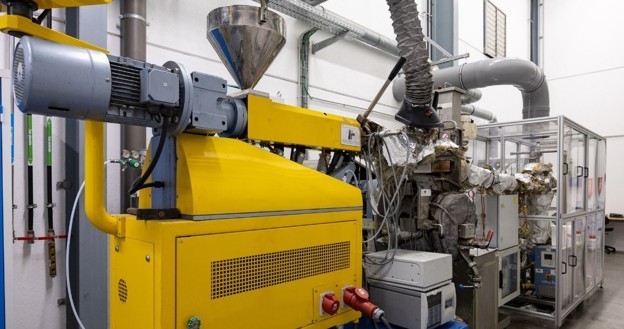
Figure 1. TPE/TPO pyrolysis pilot line at Certech, consisting of a single-screw extruder (yellow, left) continuously feeding a 20 L reactor with collection stations (right). Image Copyright © Certech 2026.
At the pilot scale, a processing rate of several kg/h was achieved for virgin TPOs. The results confirmed the trends observed in the laboratory: a high liquid-phase yield and a low solid fraction.
Pyrolysis oils with specific characteristics
The oils produced underwent in-depth analysis using two-dimensional chromatography (GC×GC-HRTOF-MS/FID), while the generated gases were characterized by micro-gas chromatography (micro-GC).
Figure 2 shows the chromatograms obtained for pure n-paraffins (linear alkanes from C7 to C30) and for oils derived from various pyrolysis tests on two TPOs: an ethylene-1-octene copolymer ("TPO-PE") and an isotactic polypropylene-ethylene copolymer ("TPO-PP").
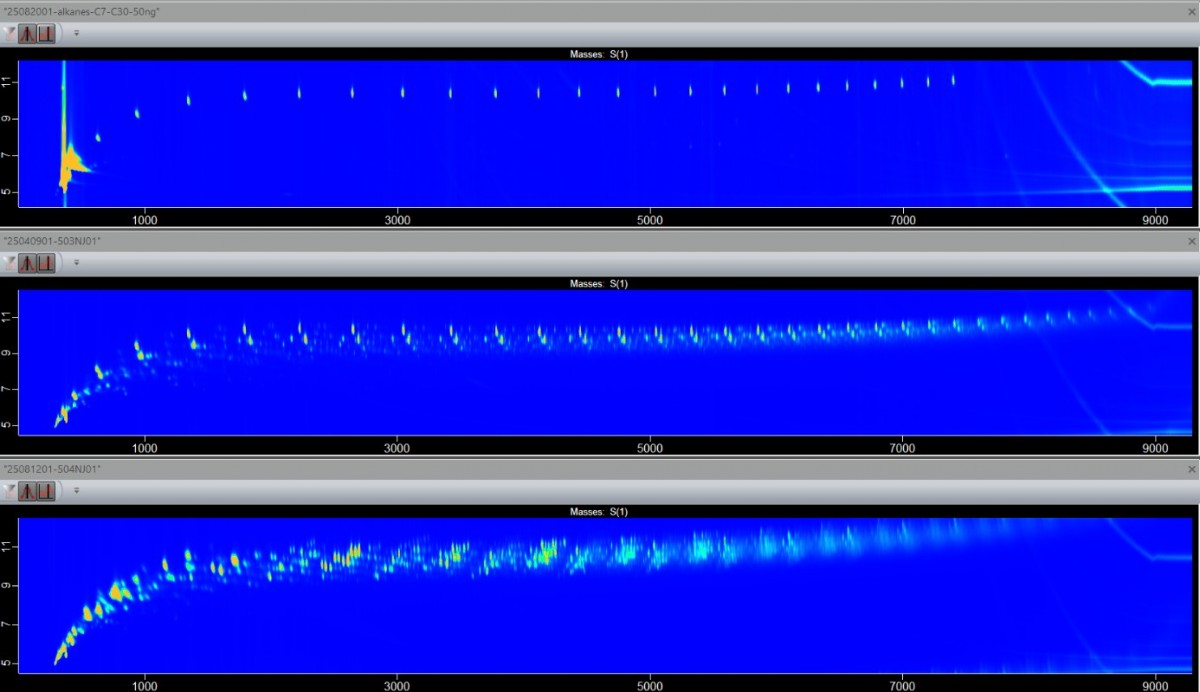
Figure 2. GC×GC chromatograms obtained for (a) a mixture of pure n-paraffins and pyrolysis oils derived from (b) an ethylene-1-octene copolymer ("TPO-PE") and (c) an isotactic polypropylene-ethylene copolymer ("TPO-PP").
These chromatograms indicate that the profiles of the TPO pyrolysis oils are more complex (Figures 2b-c) than that of the n-paraffins (Figure 2a). Unlike the oils derived from "TPO-PE" (Figure 2b), where paraffins and olefins are clearly separated, the chromatograms of oils from "TPO-PP" pyrolysis show significant overlapping zones (Figure 2c), most likely due to the presence of branched structures.
This complexity presents a key challenge, as it directly influences the properties of the oils and their potential valorization pathways. TPO pyrolysis oils (whether from TPO-PE or TPO-PP) therefore contain non-paraffinic molecules, such as olefins. The presence of olefins is a limiting factor for the valorization of pyrolysis oils in refineries as a sustainable substitute for petroleum naphtha. This aspect will be the subject of future investigations as part of the Elast2Sustain project task dedicated to chemical recycling.
A gas phase rich in valorizable compounds
Analysis of the pyrolysis gases reveals the presence of a wide variety of compounds, notably hydrogen (H2), carbon dioxide (CO2), and methane (CH4), as well as other volatile organic compounds (VOCs).
The major fraction consists of light hydrocarbons, particularly propane, propene, isobutene, and C6 compounds (Figure 3). A portion of these molecules can be condensed and recovered, which helps to further improve the overall yield of valuable liquid products. This observation applies to both TPO-PE and TPO-PP.
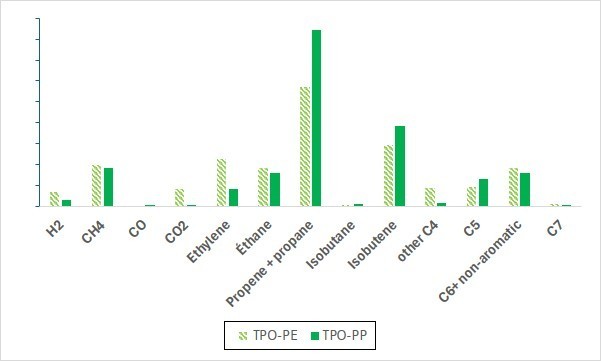
Figure 3. Examples of average volume concentrations of various compounds or families of compounds detected in the gas phases resulting from the pyrolysis of TPO-PE or TPO-PP.
Outlook
Future work will focus on intensifying reaction conditions in a pilot reactor, improving the quality of the oils obtained through post-treatment, and extending the process to more complex feedstocks, particularly waste TPOs.
This work confirms the potential of chemical recycling via pyrolysis as a complementary lever for enhancing the circularity of elastomer materials and contributing to the development of a more sustainable plastics economy.
Thumbnail has been created with the assistance of AI.


