
Within the Elast2Sustain project, the Sustainable Materials Lab (SusMat, Department of Chemical Engineering, KU Leuven, campus Kulak Kortrijk) is investigating targeted chemical depolymerization as a means of converting thermoplastic elastomers based on condensation polymers, such as polyesters, polyamides and polyurethanes, back into monomers from which new virgin polymers can be produced again.
Combinations with other polymers are also being studied, including with polyolefins, PVC, and cellulosic fibres (e.g. cotton). Depolymerization conditions are optimized so that the non-targeted polymers are not affected and can still be physically or chemically recycled using other techniques in a subsequent step.
Optimization of all reactions has been carried out at laboratory scale. Scale-up of the reactions will be investigated later in the project with the installation of a scale-up reactor at SusMat by the end of 2026.
Targeted chemical depolymerization of polyesters, polyamides and polyurethanes
Polyesters
Before the start of Elast2Sustain, SusMat had already developed a method to efficiently and completely depolymerize polyesters into monomers at 120°C in less than one minute using potassium hydroxide in methanol (patent application PCT/EP2022/068334). This method was also applicable to mixtures of polyesters and polycarbonates, where both could be completely broken down into monomers. Within Elast2Sustain, the method was further optimized for combinations with other polymers (cellulose fibres, PVC and polyolefins) to ensure that the other non-targeted polymers were not affected or degraded. After optimization, polyester could be completely removed from mixtures within one minute at temperatures below 90°C, while polyolefins and cotton showed no degradation. For PVC, lower temperatures and longer treatment times were required, and depended on how the PVC-polyester composite had been formulated.
Polyamides
For polyamide treatment, SusMat developed two complementary techniques, each with specific advantages and disadvantages. The first applies the same treatment method used for polyesters (potassium hydroxide in methanol), although a longer treatment time of 1 to 1.5 hours is required to achieve complete conversion into monomers. An advantage is that, in mixtures containing polyesters, the polyester fraction can be depolymerized first with minimal degradation of and contamination by polyamide-derived monomers. The polyamide can then be converted afterwards. This method also allows selective removal of polyamide fractions from block copolymers in which polyamides are chemically linked to other polymers.
A second method, called ALCHYD+, was developed in which polyamides are selectively dissolved in an aqueous solvent without depolymerization, enabling physical separation. They can then either be precipitated and recovered as polymers or depolymerized into monomers within half an hour without changing solvent. This latter process is known as WALCHYD+ and was protected by patent application PCT/EP2025/068533.
Polyurethanes
A successful two-stage methodology was also developed for polyurethanes (and polyureas). Thermoplastic polyurethanes are first dissolved in a solvent, allowing physical separation. They can then either be recovered as polymers without degradation or converted into basic chemicals and monomers after addition of a depolymerization reagent. Complete depolymerization could be achieved within 10 minutes at 120°C. This methodology, known as ElasHyd, is also protected through patent application PCT/EP2025/068533.
Combination of depolymerization techniques
As combinations of different polymers are increasingly used to better match end-use requirements, polymer combinations that are difficult to separate will also become more common in waste streams. Examples include polyester-cotton non-iron fabrics, cotton-polyurethane stretch denim, and polyamide-polyurethane stretch sportswear. It is therefore important to develop a sequential method capable of selectively removing different fractions without degrading the remaining fractions, while also being adaptive so that unnecessary processing steps can be omitted.
Based on the techniques developed within SusMat, a processing flow diagram (Figure 4) was designed that combines the different steps so that each fraction can be removed separately without contamination of the others and under conditions that do not degrade the remaining fractions. Protocols for separating the different product streams and monomers were also developed.
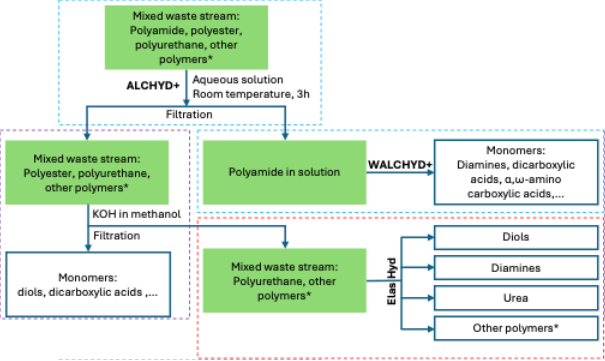
Figure 4: Combination of the different chemical depolymerization techniques in a treatment scheme for a mixed waste stream. Each section is enclosed by a colored dashed border and can be omitted if not applicable. Separation techniques for isolating the different streams and monomers were also developed within Elast2Sustain. *Other polymers that were studied include polyolefins, PVC, and cotton (cellulose). Processing conditions were developed to ensure that these materials do not degrade during the removal of the other fractions, allowing them to be recycled through alternative methods.
Outlook
The methods described above were developed on laboratory scale up to approximately 100 mL. To enable detailed techno-economic analyses, scale-up studies are required. By the end of 2026, SusMat plans to install and commission a scale-up reactor and separation train capable of isolating the obtained products. Scale-up trials of the various methodologies will then be performed to obtain industry-relevant data.
In addition, the research will be expanded to a broader range of industrial samples to further determine the effects of additives, contamination, morphology and composition on the developed strategies.
Thumbnail has been created with the assistance of AI.


